

How to Get Approved for a Business Credit Card with High Limits and Low Interest
Getting a business credit card with a “toy limit” of $2,000 when you have $50,000 in monthly inventory to buy is, frankly, insulting. It’s a common frustration for growing businesses. You need purchasing power to scale, but banks often seem hesitant to give you the keys to the car until you’ve already proven you can drive it.
If you are tired of hitting your credit limit halfway through the month or paying interest rates that make your eyes water, you need a different strategy. Securing a high-limit, low-interest card in 2026 isn’t just about filling out a form; it’s about presenting your business as a safe bet. Here is how to actually get approved for the cards that matter.
The “Unspoken” Requirement: It’s Not Just About Business Credit
Let’s rip the band-aid off: for most small to mid-sized businesses, your personal credit score is still the gatekeeper. Even if you have an LLC and an EIN, banks will almost always look at you—the owner.
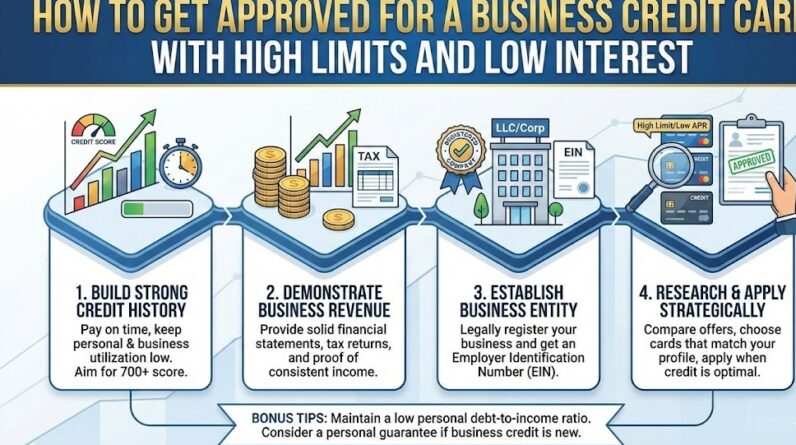
To unlock premium tiers (think $20k+ limits and single-digit interest), your personal FICO score usually needs to be north of 720. If you are hovering in the 600s, you might get approved, but you will likely get stuck with a lower limit and a higher APR. Before applying, spend a few months paying down personal balances to lower your utilization. It’s the single fastest way to boost your score and look more attractive to underwriters.
Chase the “Cash Flow” Cards
The game has changed. Traditional banks used to only care about your credit history. Now, modern fintech issuers like Ramp, Brex, or Capital One are looking at your cash flow.
These issuers can link directly to your business bank account to see your real-time revenue. If you have solid daily balances and consistent deposits, they will often grant much higher limits—sometimes 10x or 20x higher than a traditional bank—because they can see you have the cash to pay it back. If your credit score is average but your sales are strong, this is your golden ticket.
The Art of the “0% APR” Shuffle
If your goal is low interest, you shouldn’t be looking for a low standard rate—you should be looking for no rate.
The best hack for growing businesses is to target cards offering 0% introductory APR for 12 to 18 months (like the Chase Ink Business Unlimited or Amex Blue Business Plus). This essentially gives you an interest-free loan for over a year. Use this period to finance big equipment purchases or bulk inventory. Just be disciplined enough to pay it off before the promo period ends, or that interest rate will jump aggressively.
Don’t Guess Your Income
When the application asks for “Gross Annual Revenue,” do not be modest, but do not lie. Many business owners mistake “profit” for “revenue.“
Banks lend based on revenue—the total money coming in the door before expenses. If you put down your net profit instead of your gross revenue, you are accidentally telling the bank you are smaller than you are. Accurately reporting your total top-line revenue is often the difference between a $5,000 limit and a $25,000 limit.
Relationship Banking Still Works
In an age of algorithms, humans still have pull. If you already have a business checking account with a bank (like Chase or Bank of America), apply for their card.
You are not a stranger to them. They can see your average daily balance and your history. If you go into a branch and speak to a business banker, they can sometimes override an automated decline or push for a higher starting limit based on your relationship. It feels old school, but it works.
The Bottom Line
High limits are earned, not given. Start by ensuring your personal credit is clean, leverage your cash flow data if you have high revenue, and don’t be afraid to pick up the phone and negotiate. Banks want to lend to businesses that are growing—you just have to prove that you are one of them.